Step by step
How to register with a GP in England, and what to do if you are refused
Registering with a GP in England takes about fifteen minutes and requires far less documentation than most people believe. The rules are clear and in your favour. The problem is that practices sometimes apply their own stricter version of them.
In short
- You do not need photo ID, proof of address, an NHS number or immigration documents.
- If you have no fixed address you can use a temporary address, a day centre or the surgery's own address.
- A practice may only refuse for defined reasons and must tell you why in writing.
- You can start using services before your records finish transferring.
Step 1: find practices that cover you
Use the NHS "Find a GP" service and search by postcode. Practices have boundary areas, and this is one of the few grounds on which they can legitimately decline you. Note two or three options rather than one: some will have closed their lists temporarily.
Step 2: complete the form
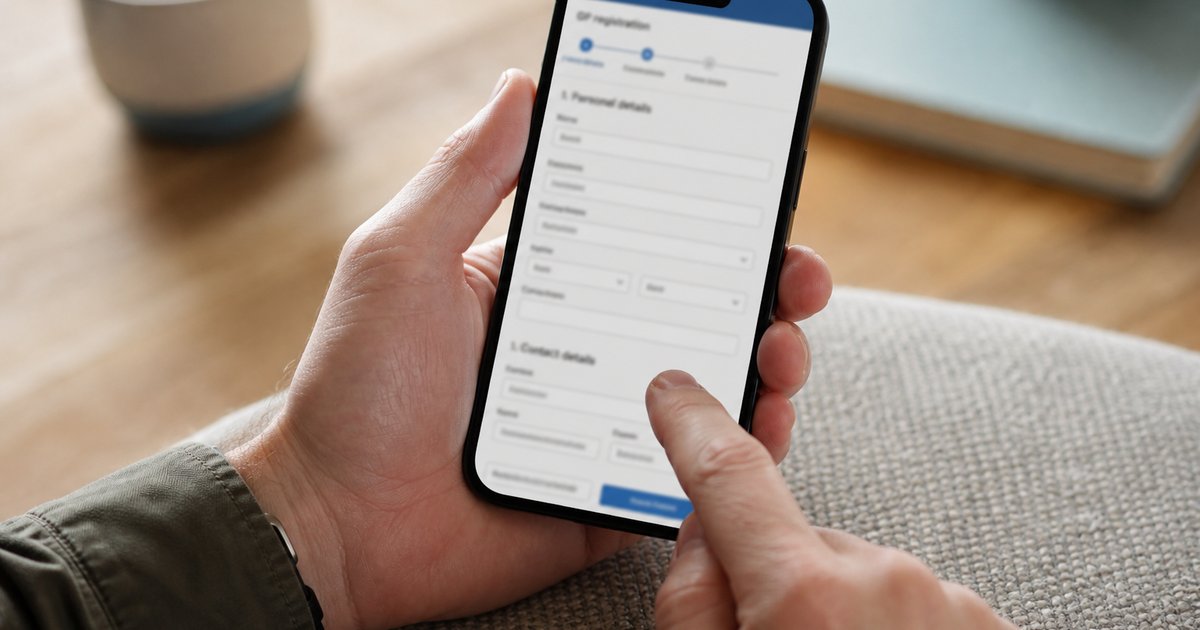
Most practices accept online registration, and there is also a central NHS registration service that works across many practices. If the online route fails for technical reasons, ask for a paper GMS1 form at reception; practices are required to accept it. The form asks for your name, date of birth, contact address, and details of any previous practice.
Step 3: know what you do not have to provide
This is the part that goes wrong most often. NHS England guidance is explicit that there is no contractual duty on a practice to seek evidence of identity, immigration status or proof of address, and that practices should not refuse registration because a patient cannot produce such evidence. In practice a large share of surgery websites still list ID as required.
Bringing documents does speed things up, because it helps the practice locate your existing records. But being unable to bring them is not a lawful reason to turn you away. If you have no fixed address, you may register using a temporary address, a hostel or day centre address, or the surgery address itself.
Step 4: wait for confirmation
The practice has up to five working days to process the registration, and many do it faster. Transfer of your electronic record from a previous practice takes longer, typically two to four weeks. You do not need to wait for that transfer to book an appointment or request medication; tell the clinician what you take and they will verify it.
If you are refused
A practice can decline you only for defined reasons, principally that its list is closed to new patients or that you live outside its boundary. It must give you the reason in writing, generally within fourteen days.
- Ask for the refusal, and the reason, in writing. Do this politely at the desk and follow up by email so you have a record.
- Check the reason against the two legitimate grounds above. "You have no ID" and "you cannot prove your address" are not among them.
- Contact NHS England on 0300 311 22 33 if the refusal was not on legitimate grounds. They can direct you to a practice that must accept you.
- Ask a local Healthwatch for support if you are getting nowhere. This is exactly what they exist for and the help is free.
Special situations
Staying somewhere temporarily
If you are away from home for more than 24 hours but less than three months you can register as a temporary patient without giving up your existing registration.
Students
You can register at your term-time address. Many universities have an affiliated practice, but you are not obliged to use it.
Newly arrived in the UK
Register in your first week rather than waiting until you are ill. GP registration and treatment are not restricted by immigration status, and the record you build from day one is what makes later care coherent.
After registering
Two housekeeping tasks are worth doing immediately. Set up the NHS App, which gives you your NHS number, repeat prescriptions and access to parts of your record. And check whether you are entitled to free prescriptions or help with health costs before you pay for anything — the categories are wider than most people assume, and they are covered in our health costs guide.
Common questions
Can a GP refuse me because I am not a British citizen?
No. GP registration is not restricted by immigration status and practices should not ask for immigration documents as a condition of registering.
How do I find my NHS number?
It is issued after registration and appears in the NHS App and on most letters from the NHS. You do not need it in order to register.
Can I stay registered with my old GP after moving?
Only if your new address falls within their boundary, or the practice agrees to keep you as an out-of-area patient without home visits.
Does registering cost anything?
No. Registration is free and no practice may charge for it.