Money and paperwork
Help with NHS health costs: certificates, the Low Income Scheme and refunds
There are four separate mechanisms for reducing NHS charges in England and they do not overlap neatly. Most people qualify for one of them and apply for none. Here is the order in which to work through them.
In short
- A prepayment certificate caps prescription costs but does not touch dental or optical charges.
- The NHS Low Income Scheme covers prescriptions, dental charges, sight tests and travel to hospital.
- Ask for an FP57 receipt at the moment you pay, or you cannot claim a refund later.
- Medical exemption certificates cover named long-term conditions and must be renewed.
1. Check automatic exemption first
Before applying for anything, check whether you are already exempt. Age, pregnancy, certain benefits and a defined list of long-term medical conditions all confer exemption without an application, or with only a simple certificate. The NHSBSA eligibility checker takes about a minute and is the correct starting point, because everything below is unnecessary if this applies.
Medical exemption certificates
If you have one of the specified conditions — the list includes diabetes treated by medication, epilepsy requiring continuous anticonvulsant therapy, hypothyroidism, and cancer among others — you can apply for a medical exemption certificate through your GP using form FP92A. It exempts you from prescription charges for all your medicines, not only those for the qualifying condition. It expires, and it does not renew itself. Diarise the date.
2. Cap what you cannot remove: the prepayment certificate
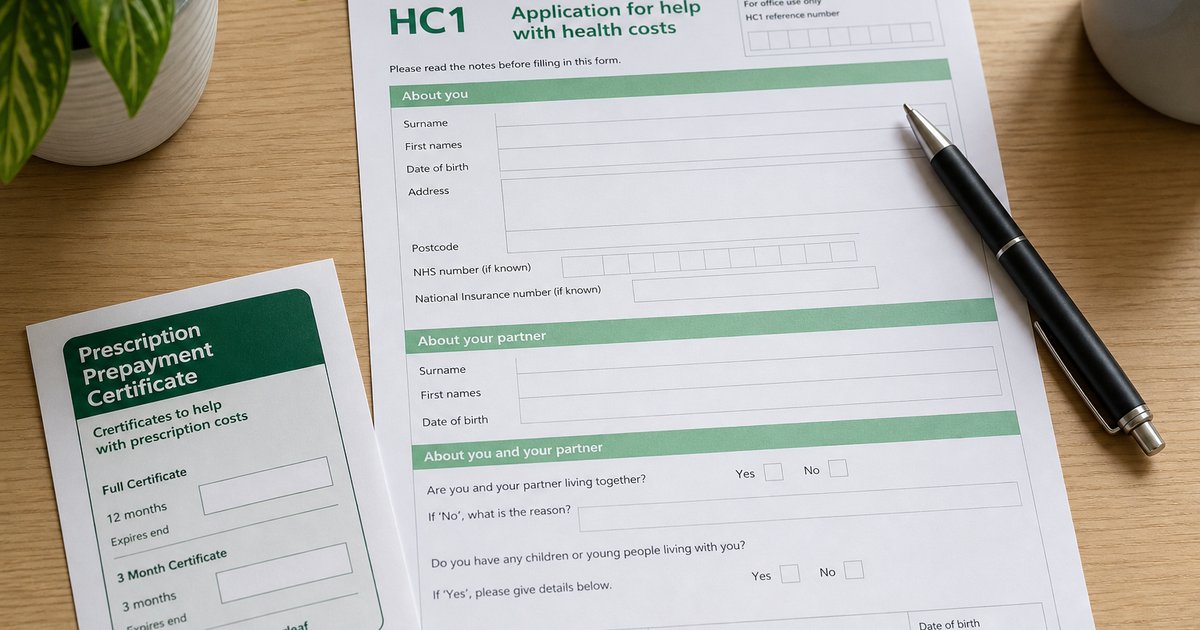
If you are not exempt but take regular medication, a prescription prepayment certificate caps your prescription spend. Twelve months costs £114.50, three months £32.05, and a dedicated HRT certificate £19.80 for the year. You can buy online through the NHSBSA, by phone, at some pharmacies, or by completing form FP95. Payment by ten monthly instalments is available for the annual certificate.
The arithmetic is simple: at £9.90 an item, twelve items a year already exceeds the annual certificate. If you take one regular medicine, you are at that threshold.
3. If income is the problem: the NHS Low Income Scheme
The Low Income Scheme is the broadest instrument and the least used. You apply on form HC1. A successful application produces either an HC2 certificate, giving full help, or an HC3 certificate, giving partial help.
What it covers is wider than prescriptions alone:
- NHS prescription charges
- NHS dental treatment charges
- NHS sight tests and vouchers towards glasses or contact lenses
- Necessary travel costs to receive NHS treatment under the care of a consultant
- NHS wigs and fabric supports
Savings and capital are taken into account, so it is not purely an income test. Students, pensioners on modest incomes and people whose earnings fluctuate are the groups most likely to qualify and least likely to apply.
4. Claim back what you have already paid
This is where the process is unforgiving about timing.
- Prescriptions. Ask for an FP57 refund receipt at the till, at the moment you pay. It cannot be issued afterwards. The form itself tells you the deadline for claiming.
- Dental charges. Use form HC5(D). Refunds take roughly six to eight weeks.
- Travel costs. Claim at the hospital cashier's office on the day where possible, taking your appointment letter and evidence of entitlement.
The general rule across all of these is three months from the date you paid, so do not let a claim sit.
Putting it in order
- Run the eligibility checker. If you are exempt, stop here.
- If you have a qualifying condition, apply for a medical exemption certificate through your GP.
- If your income is low, apply to the Low Income Scheme on HC1 — it covers more than prescriptions.
- If none of the above applies and you take regular medication, buy a prepayment certificate.
- Whatever you pay in the meantime, take the receipt.
Common questions
Can I hold a PPC and an exemption certificate at once?
You can, but there is no point. If you are exempt you should not be paying charges at all. Cancel the certificate and you may get a partial refund.
Does the Low Income Scheme affect my benefits?
No. An HC2 or HC3 certificate is help with health costs and is not treated as income.
How long does an HC1 application take?
Typically a few weeks. Keep paying and keep your receipts in the meantime so you can reclaim.
Is help with hospital travel costs real?
Yes, under the Healthcare Travel Costs Scheme, for people receiving qualifying benefits or holding an HC2 or HC3 certificate, where the treatment is under the care of a consultant.